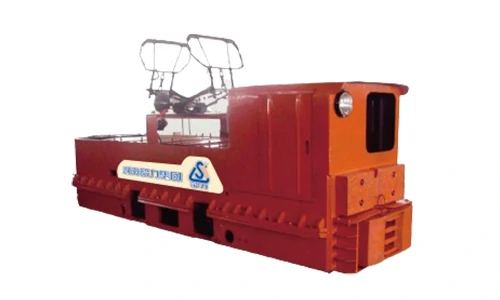
In the underground tunnels and open-pit mining areas of large mines, overhead-line electric locomotives, like ceaseless steel dragons, undertake the crucial tasks of transporting ores, materials, and personnel. Compared with other transportation equipment, overhead-line electric locomotives have become core equipment for efficient mining production, thanks to a series of remarkable advantages.
The most prominent features of overhead-line electric locomotives lie in their compact and flexible structure as well as powerful performance. With a small external dimension, they can easily navigate through narrow mine tunnels, solving the problem that large equipment has difficulty accessing complex working environments. The design of a short wheelbase and a small turning radius enables them to turn flexibly in mining areas with frequent curves, greatly improving transportation efficiency. Moreover, they possess astonishing speed and strong traction force. Even during heavy-load transportation, they can still travel quickly and smoothly, efficiently delivering ores and other materials to designated locations, providing solid transportation support for mining operations.
In terms of speed regulation technology, overhead-line electric locomotives adopt two advanced methods: chopper speed regulation and frequency conversion speed regulation. Chopper speed regulation precisely adjusts the motor voltage by controlling the conduction time of thyristors, achieving smooth speed regulation. It can quickly adjust the vehicle speed according to actual needs in different transportation scenarios, ensuring both transportation efficiency and driving safety. Frequency conversion speed regulation, on the other hand, utilizes a frequency converter to change the power supply frequency of the motor, thus achieving precise control of the motor speed. This speed regulation method has the advantages of energy efficiency, a wide speed regulation range, and smooth starting, enabling it to better adapt to the complex and changeable mining transportation conditions, effectively reducing equipment energy consumption and extending the service life of the equipment.
The diversity of the braking system is another highlight of overhead-line electric locomotives. The locomotives are equipped with multiple braking methods, including handwheel mechanical braking, electric pushrod braking, electrical braking, and air braking. As a traditional and reliable braking method, handwheel mechanical braking can respond quickly in emergency situations, ensuring that the locomotive stops in time. Electric pushrod braking, through an electric device to push the braking mechanism, is more convenient and labor-saving to operate, suitable for routine braking during daily transportation. Electrical braking uses the power generation principle of the motor to convert the kinetic energy of the locomotive into electrical energy and feed it back to the power grid, achieving wear-free braking. This not only effectively reduces the wear of braking components but also saves energy. With its strong braking force, air braking plays a crucial role in complex working conditions such as heavy-load downhill driving, providing comprehensive protection for the safe operation of the locomotive.
In terms of shock absorption design, overhead-line electric locomotives adopt innovative V-shaped rubber springs. These springs have excellent elastic and damping properties, which can significantly reduce the vibrations and impacts the locomotive experiences in the longitudinal, lateral, and vertical directions. Whether on rough mine roads or at track joints, V-shaped rubber springs can effectively absorb vibration energy, reduce the wear between various components of the equipment, and improve the reliability and stability of the equipment. Meanwhile, the rubber elastic wing plates used for the wing plates can effectively cushion the impact force of materials on the locomotive during the ore unloading process, minimizing the impact on the equipment, reducing equipment damage to the greatest extent, lowering maintenance costs, and extending the service life of the equipment.
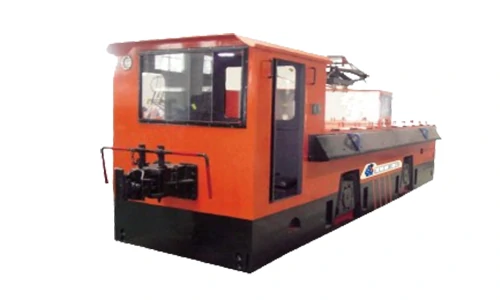
To meet the operational requirements of different mines, overhead-line electric locomotives are designed in three types: single cab, double cab, and central cab. The single cab has a compact structure, suitable for mine scenarios with limited space and relatively simple operation processes, effectively reducing equipment costs. The double cab design facilitates the operation of the locomotive during two-way driving, eliminating the need for frequent reversing and improving transportation efficiency. It is especially suitable for long-distance and high-volume transportation tasks. The layout of the central cab provides a wider field of vision during the locomotive’s operation, making the driver’s operation more comfortable. It also helps with the balance and weight distribution of the locomotive, enhancing the driving stability of the locomotive under complex road conditions. It is suitable for mining operation environments with high requirements for operation comfort and safety.
With their unique design, advanced technology, and diversified configurations, overhead-line electric locomotives demonstrate strong competitiveness in the field of large-scale mine transportation. With the continuous development of mining technology and the increasing demand for transportation efficiency, overhead-line electric locomotives will surely continue to innovate and upgrade, contributing more to the efficient, safe, and green development of the mining industry.